
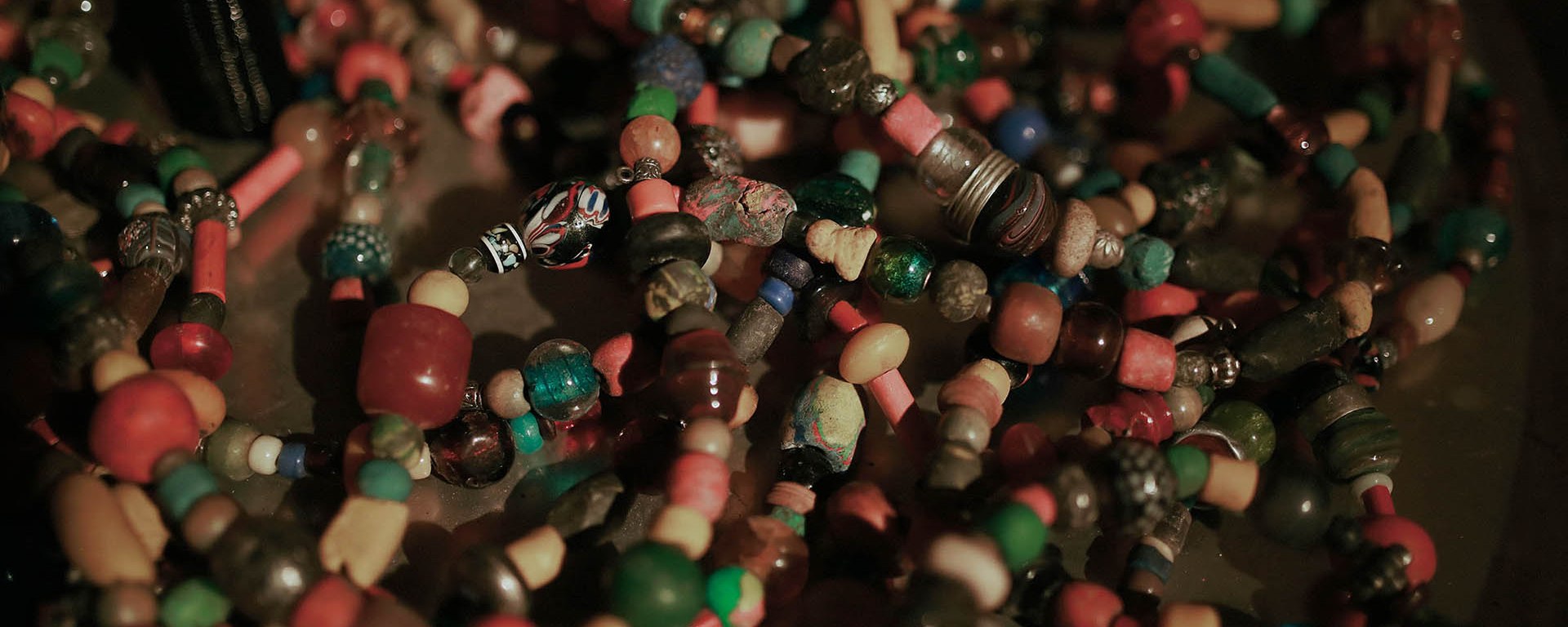
Tarek Atoui and the political gesture of sound
Tarek Atoui, born in Beirut in 1980, is a Franco-Lebanese artist and composer, and one of the most original voices on the contemporary scene. He lives and works in Paris, operating at the intersection of sound performance, visual art, and electroacoustic composition. He designs and builds unconventional instruments, blending futurism with artisanal tradition, and explores the potential of sound as a vehicle for connection, transformation, and the construction of memory.
His practice is rooted in collaborative processes that engage with marginalized communities, overlooked cultures, and landscapes in transition. Coming from a geopolitical context shaped by conflict, colonialism, and forced migration, Atoui has developed a language in which sound does not document but activates, does not represent but generates connections. It is a gesture of resistance, a shared space, a tool for care. His approach is never aestheticizing or nostalgic, but political in the truest sense: a form of non-hegemonic orality, a collective practice capable of rewriting the relationships between subjects, territories, and memories.
Two major European exhibitions — At-Tāriq (recently concluded at the Museo Nacional Thyssen-Bornemisza in Madrid) and Improvisation in 10 Days (on view at HangarBicocca in Milan until the end of July) — reflect both the complexity and consistency of his research. Autonomous yet deeply interconnected, these projects express the core of his poetics in different forms: the construction of open sonic environments, the rediscovery of oral and material traditions, and the transformative, social power of listening as a practice.
Both projects involved musicians, artisans, and researchers: in Atoui’s work, sound is never simply given — it is built, shared, and reactivated through local communities. It is a language capable of telling otherwise excluded stories, of restoring voice and dignity to subjects and territories often absent from dominant cultural narratives.
The political value of his work lies precisely here, in the way listening becomes a tool for connection, and art a space for alliances.
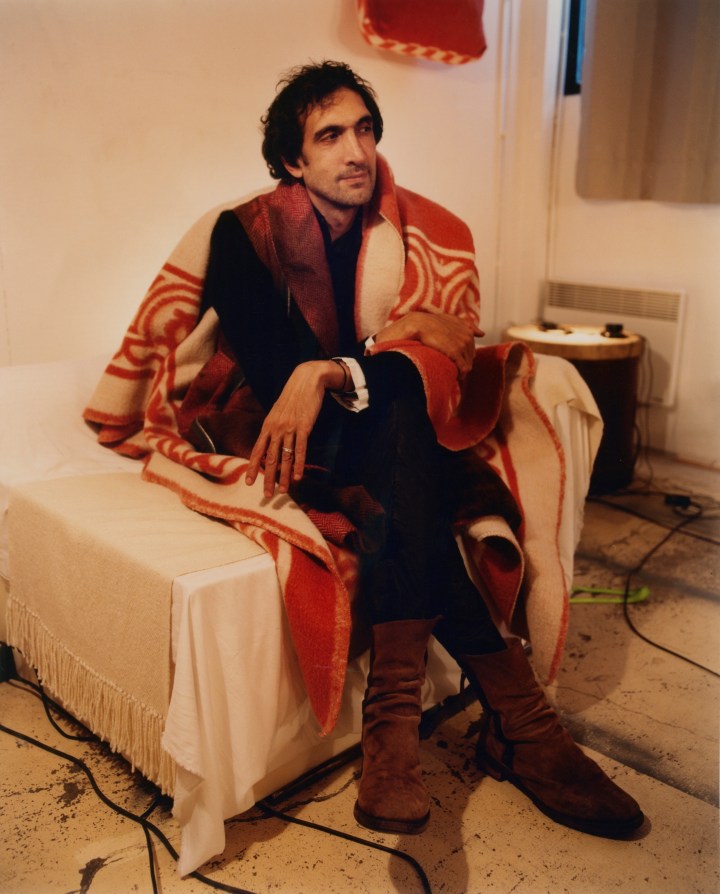
At-Tāriq: sound as a decolonial counter-narrative
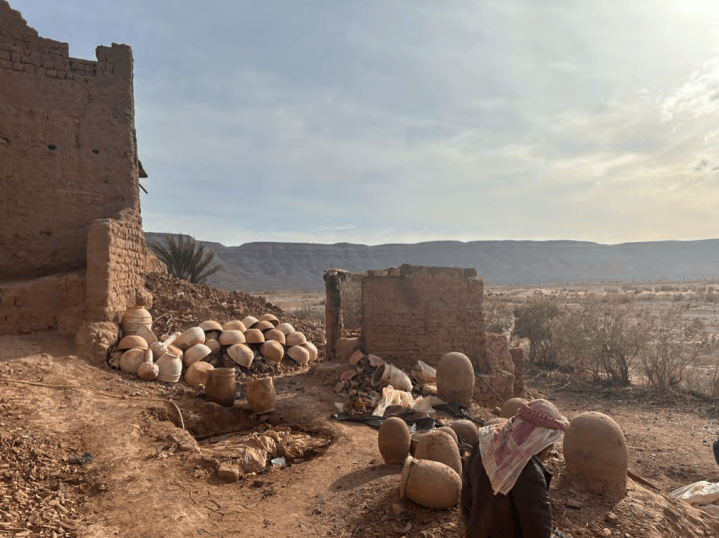
On view until last May 18 at the Museo Nacional Thyssen-Bornemisza in Madrid, At-Tāriq stands as one of the most radical and complex investigations ever undertaken by the artist. Curated by TBA21–Thyssen-Bornemisza Art Contemporary, the project is the result of a three-year research journey across rural communities in North Africa, particularly in the High Atlas region of Morocco. The exhibition explores the musical practices of the Indigenous Amazigh peoples, which are often overlooked or reduced to folklore by postcolonial frameworks.
In the 1970s, these communities coined the term “Tamazgha” to describe the lands they have traditionally inhabited: stretching from Egypt to Morocco, Tamazgha encompasses an incredibly diverse array of political, cultural, and linguistic identities — a manifestation of what it means to move beyond a singular notion of homeland or territory, and instead unite lived and collectively felt experiences as one shared body. In 2025, more than fifty years later, Tarek Atoui set out to do exactly that within the exhibition halls of the Thyssen-Bornemisza.
The very title of the exhibition — which in Arabic can mean “morning star” or “night visitor” — evokes a threshold, a tension between the visible and the invisible, between center and margin. Atoui works on this symbolic threshold by proposing a “poetic hospitality” that is not merely about welcoming, but about subversion: a space of sensitive openness toward the other, where forms of ancestral knowledge are not displayed but lived.
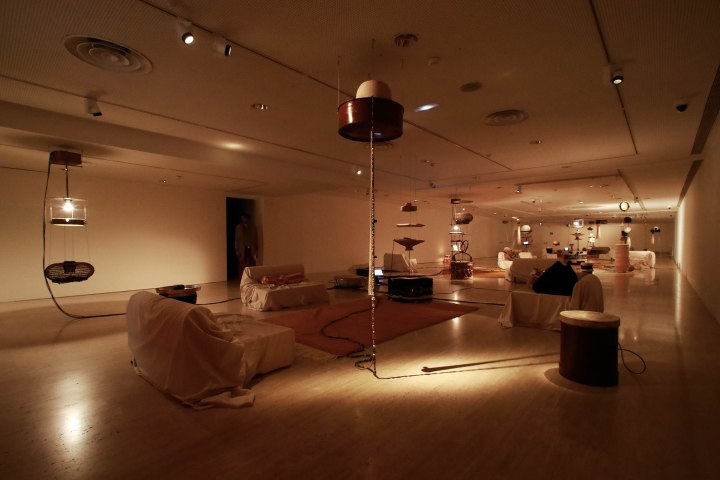
The entire exhibition unfolds across five majlis — spaces inspired by the traditional architecture of Arab hospitality, reimagined as immersive listening environments. These are conceived as a series of independent listening stations, where low seating is arranged like constellations atop carpets. There are no barriers between the stations: the soundscape can be perceived from any point, emphasizing Atoui’s vision of a single, coherent, and interconnected multichannel sonic system.
Although the seating arrangement invites introspective listening, each person remains in relation to the others — a reminder that to be human ultimately means to participate in a truly collective experience. Each room is inhabited by instruments built from local materials — ceramics, metals, textiles, stones — which resonate through optical and acoustic mechanisms, generating a composition in constant flux.
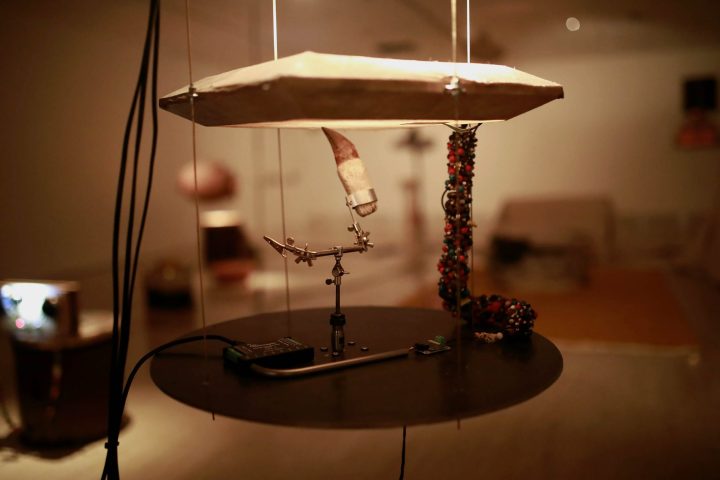
This is not about reinterpreting Amazigh sonorities through a contemporary lens, but rather about making them active agents in a dialogue that rejects exoticism and reinvents the conditions of listening. At-Tāriq thus takes shape as a decolonial counter-narrative: it does not merely make submerged, distant cultures visible but reconfigures them within the museum space, problematizing its underlying logics. Listening becomes a critical act, a tool to suspend the habit of aesthetic consumption and access a slower, political, and shared temporality.
At the heart of the exhibition is a collective composition created in Córdoba with musicians and composers Ziúr, Susie Ibarra, and Nancy Mounir. Voices, instruments, and samples layer to form a soundscape that disrupts the codes of representation: alternating between melancholy, hypnosis, torpor, and lightness, the sonic work occupies a generative space between pastoral Arabic sound and electroacoustic innovation. In this context, rurality is not nostalgia but a critical resource, a survival practice, and a form of knowledge. Craftsmanship, with its ability to transform humble materials — clay, leather, fibers, fossils — into instruments and sound objects, becomes a form of cultural ecology, capable of countering the environmental and symbolic erosion of the present.
A tribute to the resilience of Indigenous identities — wherever they take root — and to the power of historic practices, able to transcend time and remain alive.
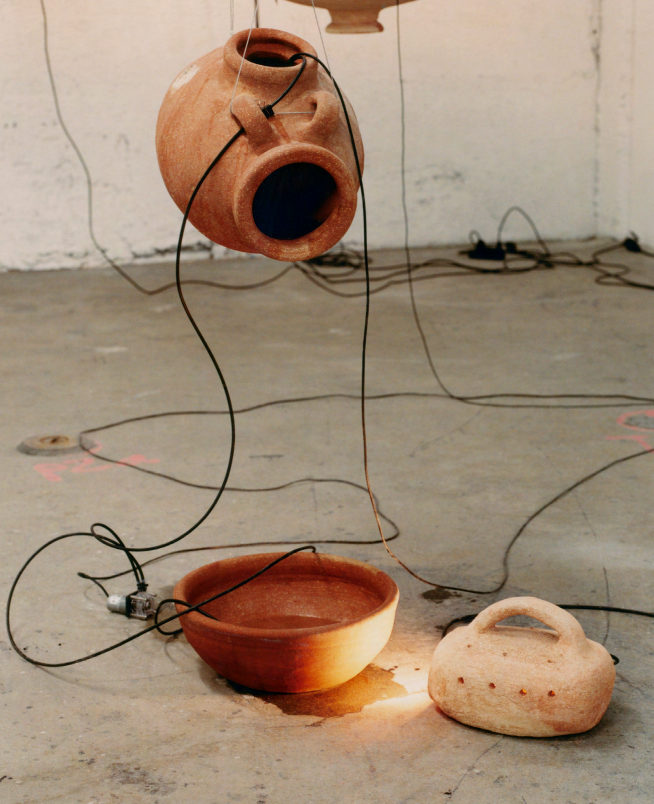
The concept of “reverberation” permeates the entire exhibition: an invitation to listen to the echoes of stories, experiences, and traditions, recognizing their enduring relevance in our present. Within the majlis, visitors are guided through themes such as memory, subjective identity, and relationships with the other; an invitation to reflect on one’s position in relation to ecological and cultural narratives that preceded us and are yet to unfold.
Remembering becomes an act of homage, and to pay homage implies reflection: Atoui urges us to reactivate legacies in the present as a gesture of hope and shared beauty for the future.
Improvisation in 10 Days: sound as relational architecture
In the Milanese exhibition Improvisation in 10 Days, curated by Lucia Aspesi, Atoui radicalizes the processual dimension: every element is in constant transformation, every sound is a relationship. The monumental space of the Shed at HangarBicocca is reconfigured into a sonic ecosystem, where materials such as bronze, paper, stone, wood, and ceramics become resonant bodies — living surfaces that respond to the presence and movement of the audience.
The exhibition rejects the notion of a closed artwork, instead privileging open and dynamic systems. Sound is made accessible through vibrations, air flows, breaths: it extends beyond hearing, involving skin, body, and multisensory perception. Here, improvisation functions both as a compositional tool and a political gesture, challenging the museum objecthood and opening space for active participation.
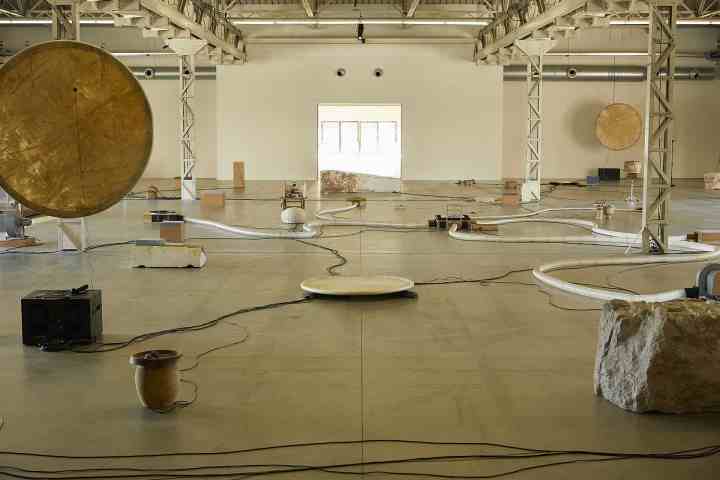
Among the most significant sections is WITHIN, which represents one of Atoui’s most important investigations into the accessibility of sound. Born from workshops conducted with deaf communities, this project explores a sensory, visual, and performative dimension of acoustic experience, transforming sound into tactile and spatial vibration. Among the works is Souffle Continu (2023–24), composed of actual “wind rooms” where visitors can perceive sound produced by airflow shaped by transparent structures through their bodies, thereby redefining the boundary between listening and physical perception.
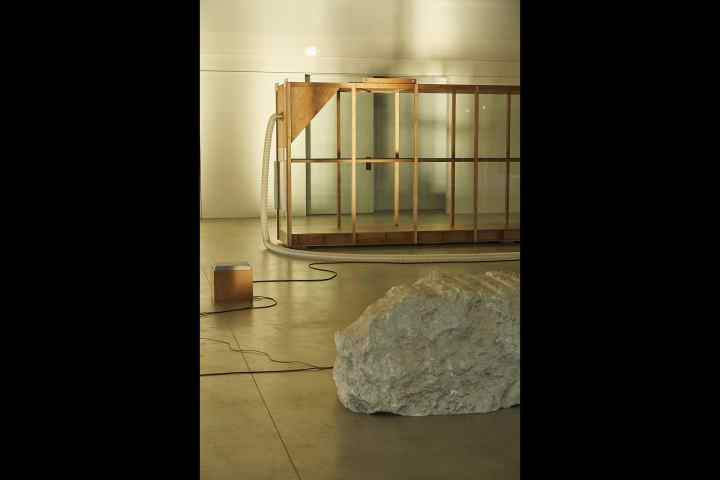
In Waters’ Witness, the ports of cities such as Beirut, Athens, Istanbul, and Sydney become sonic archives of transit, waiting, and loss. Using underwater and environmental microphones, Atoui captures the sounds of these ports — “non-places” that were once the beating hearts of their cities — transforming them into geopoetic narratives that evoke a profound dialogue between past and present, nature, history, and culture.
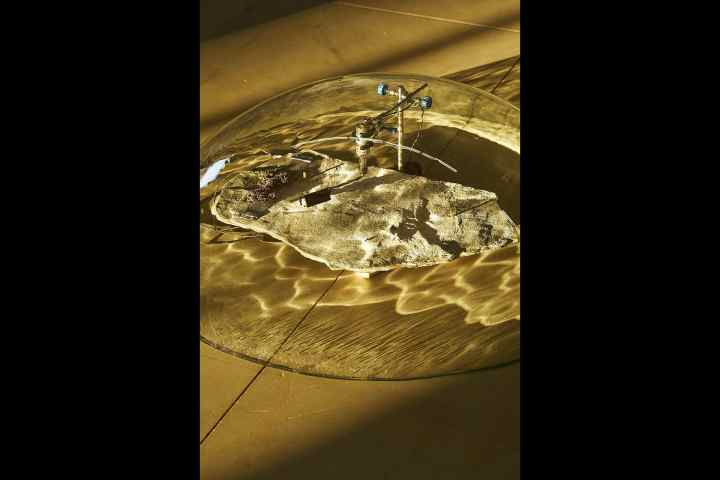
Finally, the most recent section of the exhibition, The Rain (2023–24), focuses on the sonic materiality of natural elements, with a particular emphasis on rain. Here, Atoui draws inspiration from traditional Korean techniques for making drums, ceramics, and paper to create a series of works where materials such as wood, strings, and bronze interact with technological devices that evoke the four fundamental elements — earth, water, fire, and air.
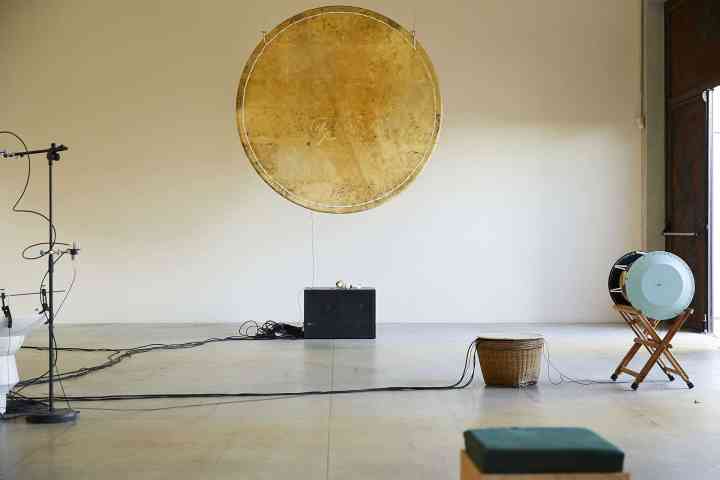
Improvisation in 10 Days is therefore much more than an exhibition: it is an open creative act that challenges conventional display formats by rethinking the relationship between space, sound, and participation. Atoui does not present artworks as fixed points but as processes in continuous evolution, where time and contingent situations become constitutive factors. The project takes shape as a device capable of generating poetic and sensitive experiences, where sound becomes emotional architecture, a collective body, and a field of relation. In this way, improvisation becomes not only an artistic practice but also an invitation to experience sound and space as events in flux, open to the unexpected and transformation.
In both exhibitions, Atoui claims sound as a radical form of presence: not decoration, but a sensitive and political exercise. Sound compels us to stop, listen, and share. It is a relational space, a means to restore dignity to excluded or forgotten subjects and narratives. At-Tāriq and Improvisation in 10 Days are ecologies of listening, micropolitics of attention, acts of care towards a world anesthetized by noise, incapable of truly hearing.
In an era where, from East to West, the roar of bombs, collapsing buildings, and a burning Earth prevail, Tarek Atoui invites us to a simple and subversive exercise: to inhabit the sounds that surround us. And, perhaps, through them, to inhabit the world differently.
Eva Chemello

